Every tester is now an AI operator — whether the job description says so or not. The real question has shifted. It is no longer whether to bring AI into your testing, but where it earns its keep, and where it quietly erodes the very quality you are paid to protect.
AI is fast, tireless, and pattern-hungry. It is also confident when it is wrong. Used with judgment, it multiplies a tester’s reach. Used blindly, it manufactures risk at scale. The difference is never the tool — it is knowing which task you are handing it.
Two questions decide everything
Before you point AI at any testing task, weigh it on two axes:
Probability — how reliably can AI produce a correct result from publicly available knowledge? Well-trodden, well-documented work scores high. Niche, proprietary, or genuinely novel work scores low.
Impact — how much does the outcome matter to product quality and to your day? A reformatted report is low impact. A generated test for a payment flow is not.
Plot any task against these two axes and it lands in one of four zones. Each zone asks for a different posture: delegate, assist, supervise, or lead.
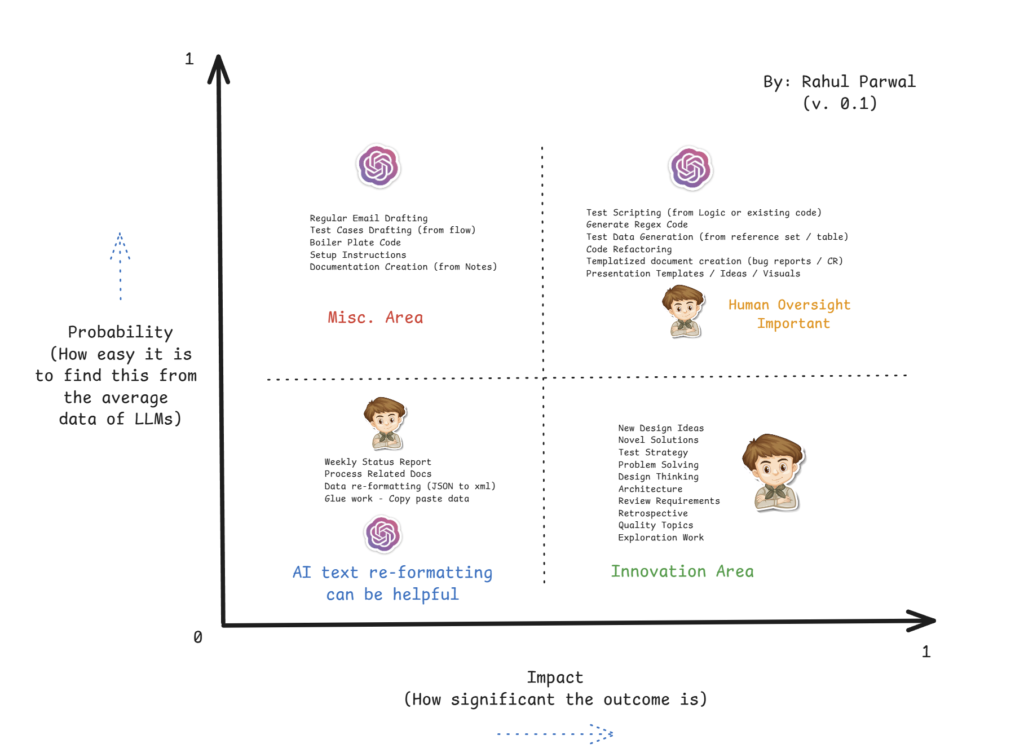
The four AI-usage quadrants for testers — mapped by probability and impact.
The four quadrants, decoded
Same tool, four very different jobs. Here is how to play each one.
01 · High Probability — Low Impact
The Automation Zone
Your posture: delegate. This is AI’s home turf — routine, well-documented, low-risk work. Hand it over and reclaim your hours for the thinking only you can do.
- Drafting test cases from a flowchart or spec
- Writing boilerplate setup and teardown code
- Producing first-pass documentation
- Composing routine status updates and emails
How to wield it: treat AI’s output as a strong first draft, never a final answer. Refine, don’t rubber-stamp.
Where it bites: generated text drifts toward bland and context-blind. Skim every line before it ships.
02 · Low Probability — Low Impact
The Formatting Helper
Your posture: assist. AI won’t dazzle here, but it removes friction. The stakes are low; the payoff is saved minutes, not saved thinking.
- Reformatting and tidying reports
- Restructuring process documents
- Converting between file formats
- Sorting and organizing raw data
How to wield it: let it reshape, rephrase, and reorganize the grunt work you’d rather not touch.
Where it bites: it can quietly mangle structured data. Verify the output still matches the input before you trust it.
03 · High Probability — High Impact
The Precision Zone
Your posture: supervise. Now the output touches product quality. AI can move fast here — but your name is on the result, so every line earns scrutiny.
- Generating test scripts from logic or code
- Crafting complex regex and matchers
- Producing structured, realistic test data
- Refactoring code for maintainability
How to wield it: let AI propose, then you validate. Steer it toward correctness with specific, testable feedback.
Where it bites: plausible-looking logic can be subtly wrong, and generated data can miss real-world edge cases. Never trust blindly.
04 · Low Probability — High Impact
The Innovation Zone
Your posture: lead. Strategy, creativity, hard-won judgment — this is human ground. AI can support the thinking, but it cannot do the thinking for you.
- Designing a test strategy from scratch
- Solving novel, context-specific testing problems
- Defining test architecture and approach
- Running a retrospective that actually changes things
How to wield it: use AI as a sparring partner — to surface patterns, stress-test ideas, and mine past data for insight.
Where it bites: it has no intuition and no scars. It can’t feel the edge case you’ve learned to smell. Lead from the front.
Putting the model to work
Automate the mundane. Documentation, formatting, routine drafts — let AI clear the low-value backlog so your attention goes where it counts.
Amplify your automation. Use AI as a coding partner to scaffold scripts, suggest refactors, and flag redundant cases — then review with a sharp eye.
Sharpen decisions. Let it surface trends, predict fragile areas, and highlight risk — but keep the interpretation human.
Fuel the strategy. Treat AI as a thinking aid for new approaches and root-cause analysis. The spark stays yours.
The principles to carry
- AI multiplies productivity — but only under human oversight.
- Some work is safe to fully automate; some demands your expertise.
- Every AI output is a draft until a human verifies it for accuracy and context.
- Use AI where it adds value, not for the sake of using it.
- Automation can be shared. Strategy stays human.
AI is here, and it is genuinely powerful. But power without judgment is just risk moving faster. The best testers aren’t the ones who use AI the most — they’re the ones who know exactly when to hand it the keys, and when to drive themselves.